Austria has banned the hand sign. France has dissolved a group. In Germany, the Bundestag has asked for a ban to be examined. In this dossier we open the official documents behind those decisions one by one, and answer each of them with history, law and sources.
Kök böri, the wolf with the sky-blue mane
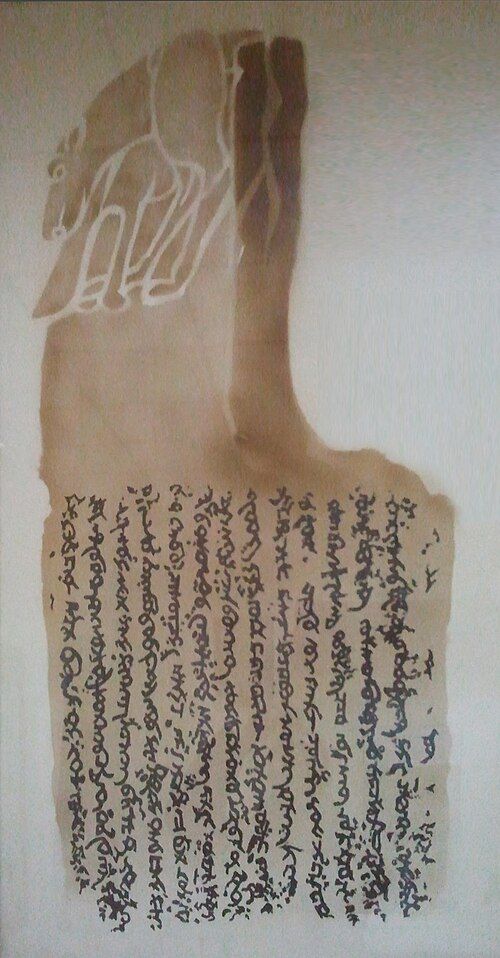
The story of descent from a wolf was recorded in the Chinese chronicle Zhoushu, completed in AD 636. The wolf relief on the Bugut inscription is half a century older still.
𐰋𐰇𐰼𐰃
𐱅𐰇𐰼𐰜Türük, in the Orkhon script
First, there was the wolf.
The Bozkurt (Grey Wolf) was not born as a party emblem. It is one of the oldest stories the Turks tell about their own origins. It was recorded not only in Turkish sources but also by the official historians of the Chinese court.
None of the records below has anything to do with modern politics. All of them are sources that anyone can check in museums, libraries and academic publications.
The Grey Wolf in the sources
Moves sideways as you scroll.
552
The first state to bear the name Türk
Bumın Kağan ends the rule of the Juan-juan (Rouran), and the Göktürk Khaganate is founded. According to the Chinese chronicles, the ruling lineage of the Turks is the Ashina, and this lineage traces its descent to a she-wolf1.
580s
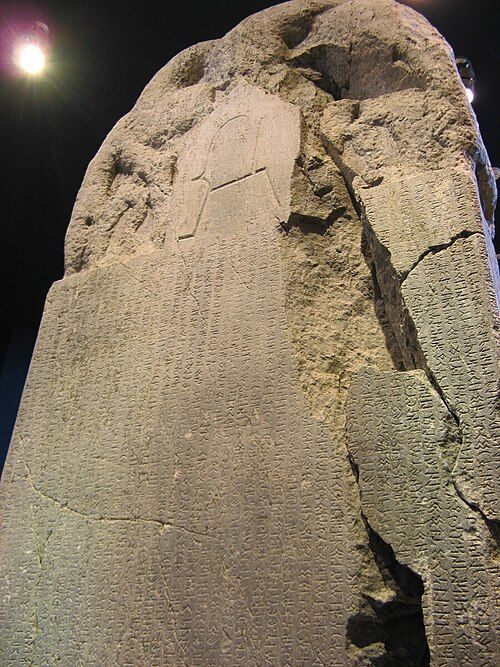
The Bugut inscription: the wolf and the child
Found in Mongolia in 1956, the inscription was erected between 584 and 587 in the name of Taspar Kağan. Three of its faces are written in Sogdian, the back in Brahmi script. The relief at the top shows a she-wolf suckling a child. The stone is now in the Arkhangai provincial museum in Tsetserleg, Mongolia2.
Image: copy of the Bugut inscription, Yastanovog, CC BY-SA 3.0
636
The Chinese court's record: a banner topped with a golden wolf's head
The Zhoushu, an official Chinese history, tells the origin of the Ashina lineage. A she-wolf feeds a boy who has survived a massacre. She gives birth to ten sons in a mountain cave, and from them the Turkic clans descend1.
旗纛之上,施金狼頭。蓋本狼生,志不忘舊。
“On top of their banners and standards they place a golden wolf's head. Because they descend from a wolf, they do not forget their origins.”
The Suishu, completed in the same year, also records that a wolf-headed standard stood at the gate of the khagan's tent, and that this was done so as “not to forget the root”3.
732
The Kül Tigin inscription: the Turks in their own letters
This monument in the Orkhon valley carries one of the most famous texts the Turks wrote in their own language and their own alphabet. The old letters you see on this site come from that alphabet: 𐱅𐰇𐰼𐰜 “Türük”, and 𐰋𐰇𐰼𐰃 “böri”, meaning wolf4.
Image: Kül Tigin monument, Betta27, public domain
13th–15th c.
The Oğuz Kağan epic: the wolf that walks ahead
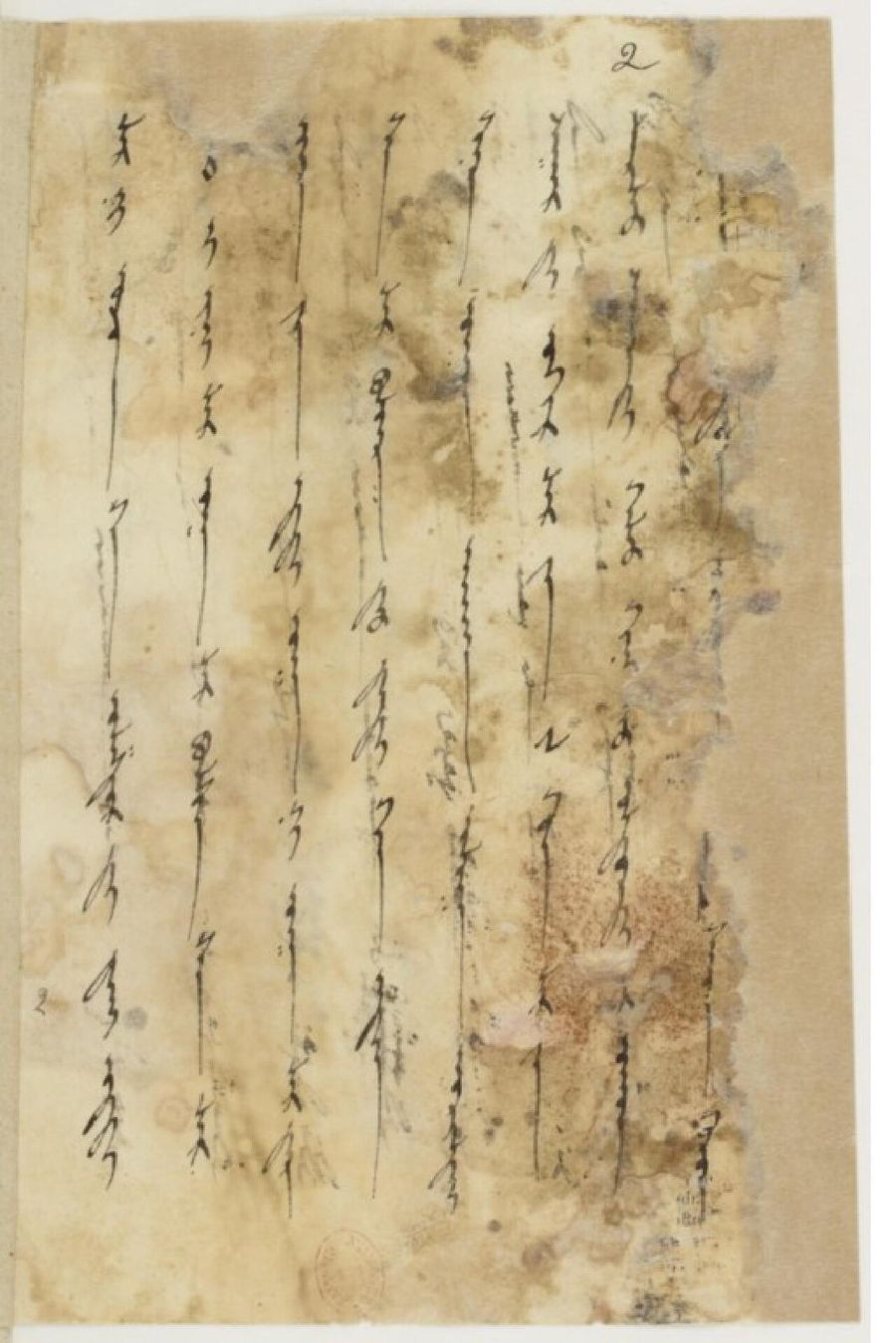
The only copy of the epic in Uyghur script is kept today in Paris, at the National Library of France (Supplément turc 1001). Its date is disputed; estimates range from the late 13th to the early 15th century5.
kök tülüklüg, kök çallug bedik bir irkek böri çıkdı
“From that light came a great male wolf with sky-blue fur and a sky-blue mane.” The wolf tells Oğuz “I will walk ahead of you” and guides the army6.
Image: Gallica / BnF, public domain. The only manuscript of this Turkish epic of the grey wolf is kept in the national library of France, the country that dissolved a group named “Grey Wolves”.
1912
Ziya Gökalp's “Ergenekon”
Ziya Gökalp, the founding thinker of Türkçülük, or Turkism (attachment to the Turkish language, history and culture), turns Ergenekon into a poem. Inside the iron mountain a wolf finds the way out, and the smith who follows it is given the name “Bozkurt”7.
It matters to get this right. In the Ergenekon accounts of Rashid al-Din in the 14th century and of Abu al-Ghazi Bahadur Khan in the 17th, the iron mountain is melted, but there is no wolf showing the way. The first known text in which the wolf shows the way is Gökalp's poem8.
1927
The Grey Wolf on the Republic's money
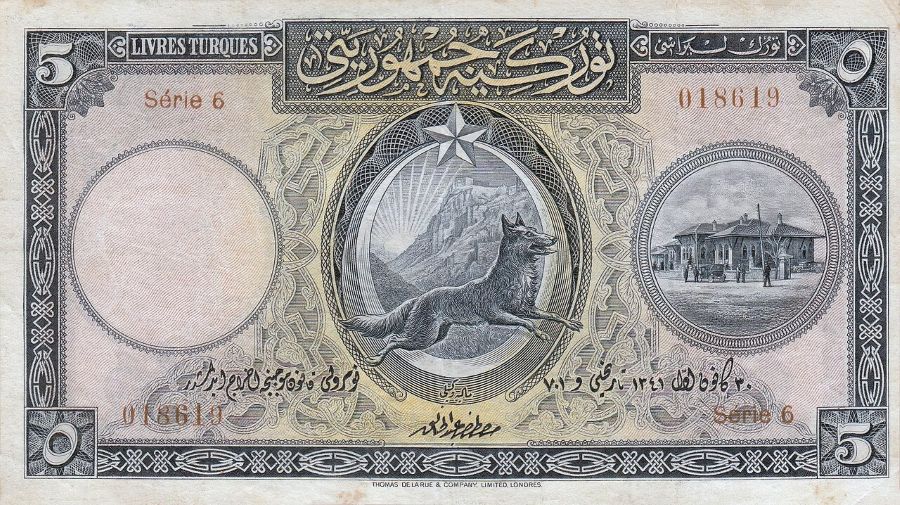
The first banknotes of the Republic entered circulation on 5 December 1927. On the front of the 5 and 10 lira notes, a grey wolf appears together with Ankara Castle9. From 1926 onwards, the 10 para stamps also carried the motif of “the legendary smith and the grey wolf”10.
In other words, the Grey Wolf was a national symbol on the young Republic's official money and stamps more than 40 years before the Ülkücü movement was founded.
Image: Central Bank of the Republic of Türkiye, 1927, public domain
1968
The Ülkücü movement is founded
The organisation of the Ülkücü movement dates back to 196811. By then, counting from the Bugut inscription, the Grey Wolf symbol was about 1,400 years old. A movement adopting a symbol does not make that symbol the movement's property.
1990s
The hand sign spreads
Today's hand sign became widespread in the early 1990s. According to one account, Alparslan Türkeş learnt the sign in 1991 from young Gagauz Turks visiting Ankara, who had in turn seen it among young Ülkücü supporters in Istanbul12. Another account says that Türkeş used the sign in Baku in 1992.
2019
Austria bans the sign
On 1 March 2019 an amendment to the Symbols Act (Symbole-Gesetz) enters into force. The “Grey Wolves” group is added to the law that bans the symbols of ISIS and al-Qaeda, and for the first time the law also covers hand signs1314.
2020
France dissolves, Germany debates
On 4 November France announces that it has dissolved a de facto group called “Les Loups gris”15. On 18 November the German Bundestag adopts a resolution asking for bans on Ülkücü associations to be examined16.
2024
The stadium and the fine
On 1 January the maximum fine in Austria rises from €4,000 to €10,00017. On 2 July in Leipzig, Merih Demiral's goal celebration earns him a two-match ban from UEFA18.
2026
No ban, and the tone is changing
The European Parliament's resolution of 17 June 2026 no longer contains the 2021 wording about “adding to the terrorist list”19. In July 2026 the German Federal Government states that it does not comment on ban assessments. In Germany, the sign and the associations remain legal20.
Europe grew up with the wolf too
The wolf also lives on in Europe's own founding legends and civic coats of arms. Europe looks at these symbols in their context. We ask that the Turkish wolf be judged by the same standard.
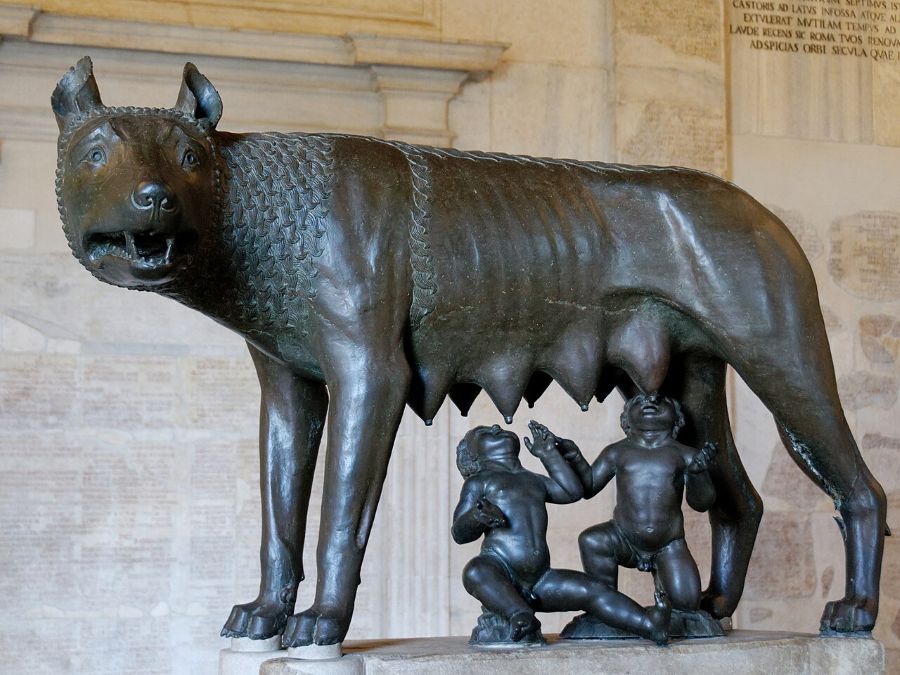
Rome's she-wolf
In Rome's founding legend, a she-wolf suckles Romulus and Remus. The bronze wolf in the Capitoline Museums has stood there since 1471; the figures of the twins were added in the 15th century21.
The parallel with the Ashina legend is striking: both peoples trace their origins to a she-wolf that nursed a child.
Image: Jastrow, public domain
The wolf in German and Austrian coats of arms
Since 1432 the coat of arms of Passau has shown a red wolf rampant on a silver field. The arms of Wolfsburg show a golden wolf walking on the battlements of a castle. The arms of Wolfsberg, a town in the Austrian state of Carinthia, also feature a black wolf22.
No one would think of banning these coats of arms, because their context is clear. That standard of context is exactly what we are asking for.
Germany judges its own wolf symbol by context
The wolf hook (Wolfsangel) was used by SS units in the Nazi era, and by a neo-Nazi youth organisation that was banned in 1982. Even so, Germany's Federal Office for the Protection of the Constitution (BfV) writes:
„Davon unabhängige Verwendungen, wie z. B. in Stadt- und Vereinswappen sind nicht strafbar.““Unrelated uses, for example in the coats of arms of towns and associations, are not punishable.”23
Germany looks at context even for a symbol the Nazis used. Asking for the same standard to be applied to a 1,400-year-old Turkish symbol is not a request for privilege. It is a request for equality.
The documents in the dossier
Three countries, three different paths. Austria banned the sign. France dissolved a group. Germany has so far banned neither the sign nor the associations.
Look at the table first, then at the documents themselves. For each document we have summarised the other side's reasoning without distorting it, and then written our answer.
Where things stand today
As of 27 October 2026, according to official documents.
Country
Hand sign
What was done?
Legal basis
Sanction
Austria
BannedSince 1 March 2019
The “Grey Wolves” group was added to the Symbols Act; the hand sign was described in a regulation.The Constitutional Court requires each case to be examined separately.
Symbole-Gesetz § 1 Z 4BGBl. I Nr. 2/2019 and BGBl. II Nr. 58/2019
Administrative fine of up to €10,000Up to €20,000 for a repeat offence (since 2024)
France
Not banned
A de facto group called “Les Loups gris” was dissolved.4 November 2020, decree of the Council of Ministers
Code de la sécurité intérieure, L. 212-1Points 1° and 6°
Continuing the dissolved group is an offenceThe sign itself is permitted
Germany
Not banned
In 2020 the Bundestag asked for bans on associations to be examined; no ban has followed to date.
§ 86a StGB does not applyIt covers only the symbols of banned organisations
MonitoringBfV report estimates 13,500 people (2025)
EU
No ban
In 2021 the European Parliament called for terrorist listing and a ban on associations to be examined; its 2026 resolution did not mention the terrorist list.
Parliament resolutions are recommendationsNot binding
Not on the EU terrorist list
The documents, one by one
When you open a document, you see its original title, what it says, the reasoning behind it and our answer, all in one place.
Ban
AustriaFederal act, BGBl. I Nr. 2/2019
Bundesgesetz, mit dem das Symbole-Gesetz geändert wird
Federal act amending the Symbols Act
Brought the “Grey Wolves” group within the scope of the banned symbols, and extended the law to cover hand gestures as well as badges and emblems. Entered into force on 1 March 2019.
Bundesgesetz, mit dem das Symbole-Gesetz geändert wird
In English: Federal act amending the Symbols Act. Federal Law Gazette BGBl. I Nr. 2/2019, 9 January 2019. In force: 1 March 2019.
What does the document say?
The law was passed in 2014 to ban the symbols of ISIS and al-Qaeda. The amendment added the “Grey Wolves group” to Section 1 as a fourth item. In Section 2, the phrase “badges and emblems” became “badges, emblems and gestures”. For the first time in Austrian law, a hand gesture could now be banned13.
„Als Symbole sind auch Abzeichen, Embleme und Gesten anzusehen.“
Their reasoning
The law rests on the assumption that the listed groups hold an ideology that calls for violence, and that displaying their symbols in public spreads that ideology24. Alongside the Grey Wolves, the law also covers the symbols of organisations on the EU terrorist list.
Our answer
The symbol and the group are not the same thing. The law targets the “Grey Wolves group”, but the wolf that the sign depicts has been part of Turkish heritage since the 6th century. Groups may come and go; the symbol remains, because it belongs to no group.
Austria's own Constitutional Court has drawn a line. Before a penalty can be imposed, it must be established separately in each case that the use of the symbol endorses or propagates the group's ideology calling for violence24. A goal celebration or a family photo does not automatically meet this test.
Being in the same law as terrorist organisations is not the same as being one. The Ülkü Ocakları (Idealist Hearths) are not on the EU terrorist list25. In its 2026 resolution, the European Parliament did not repeat its call for terrorist listing19.
Practice bears this out. In 2019, the law's first year, 20 reports concerning Grey Wolf symbols were filed in the federal states outside Vienna. In Upper Austria, 8 of the 9 reports were dropped and only one led to a penalty26. We found no published official figures for later years. But the picture from the first year suggests that the ban works less as an answer to a real security need than as a symbolic stigma placed on a community.
Türkiye's official response
On 14 February 2019 the Turkish Ministry of Foreign Affairs stated that it did not accept the ban and condemned it “strongly”. It called the listing of the Grey Wolf sign alongside the symbol of a terrorist organisation such as the PKK “a complete scandal”27.
AustriaMinisterial regulation, BGBl. II Nr. 58/2019
Symbole-Bezeichnungsverordnung, Anlage Nr. 20
Symbols Designation Regulation, annex item 20
The Ministry of the Interior describes the banned symbols one by one. Item 20 of the annex defines the hand sign finger by finger; item 19 is devoted to the group's wolf emblem.
Symbole-Bezeichnungsverordnung, Anlage Nr. 20
In English: Regulation of the Ministry of the Interior amending the Symbols Designation Regulation. BGBl. II Nr. 58/2019, 27 February 2019. Annex items 15–23 entered into force on 1 March 201914.
What does the document say?
The annex to the regulation describes what the banned symbols look like. The hand sign is defined as follows (text taken from the 2024 ruling of Austria's Supreme Administrative Court28):
„Handzeichen der Gruppierung „Graue Wölfe“ (sog. „Wolfsgruß“), der Daumen wird mit dem Ring- und Mittelfinger zusammengelegt, der Zeigefinger und der kleine Finger stehen dabei nach oben ab.“
Their reasoning
For a ban to be enforceable, what is banned has to be defined in concrete terms. That is why the regulation gives a visual description of the group's emblems and hand sign.
Our answer
The definition itself shows the problem. The hand shape it describes is almost identical to the “Schweigefuchs” (quiet fox), a gesture used in German schools to call for silence. Whether a gesture is an offence depends not on the position of the fingers but on intent and context.
The principle of legal certainty. Citizens must be able to know in advance what is an offence. The regulation does not say when the same hand shape counts as a “salute” and when it is a game or an imitation. That only becomes clear afterwards, in a police or court decision.
The ban has created uncertainty that reaches into the past. A €400 fine was imposed for a Facebook photo posted in 2016, three years before the ban. The Supreme Administrative Court overturned the fine on procedural grounds. But it held that the post remaining online after 1 March 2019 was a “continuing offence”28. So a photo from years ago can become a problem today.
The maximum fine under the Symbols Act rose from €4,000 to €10,000, and for a repeat offence from €10,000 to €20,000. Final penalties are now reported to the security authorities. Entered into force on 1 January 2024.
Verbotsgesetz-Novelle 2023, Artikel 5
In English: 2023 amendment to the Prohibition Act. BGBl. I Nr. 177/2023, 30 December 2023. In force: 1 January 202417.
What does the document say?
The package mainly amends the law banning Nazi propaganda (Verbotsgesetz). Its Article 5, however, raises the penalties under the Symbols Act. Prison terms stayed the same: up to one month, or up to six weeks for a repeat offence.
„… werden der Betrag „4 000 Euro“ durch den Betrag „10 000 Euro“ und der Betrag „10 000 Euro“ durch den Betrag „20 000 Euro“ ersetzt.“
Their reasoning
To make penalties a stronger deterrent, and to reinforce the fight against extremist symbols within a single package.
Our answer
The Turkish wolf symbol, in the same legislative package as Nazi propaganda. Placing them side by side has no historical basis: the Grey Wolf is more than 1,300 years older than Nazism.
Deterrence should target violence, not a hand gesture. Threats, incitement and violence are already punishable under Austrian criminal law. The penalties went up, but the vagueness of the law was not addressed.
A hand gesture on the record. Reporting final penalties to the security authorities means that a goal celebration or a photo can end up in a person's security records. This is incompatible with the principle of proportionality.
Austria's Constitutional Court required a separate examination in each case before a penalty can be imposed under the Symbols Act. In doing so, it relied on the Vajnai judgment of the European Court of Human Rights (ECtHR).
VfGH-Erkenntnis E 3120/2021
In English: Ruling of the Austrian Constitutional Court, 8 March 202224.
What does the document say?
The case concerns a demonstration that was banned outright because the flag of an organisation on the banned list (the PKK) was used at it. The Court did not find the 2019 amendment unconstitutional. But it held that banning the demonstration as a whole violated freedom of assembly, and it set the following test for a penalty:
„… mit der Verwendung des verbotenen Symboles das spezifische zur Anwendung von Gewalt aufrufende Ideengut der Gruppierung gutgeheißen oder propagiert werden …“
What it means for us
Even in Austria, the ban has limits. Using a symbol is not enough on its own. It must be shown in concrete terms that the use endorses an ideology calling for violence.
European case law is on our side. In setting this test, the Court relied on the ECtHR's Vajnai judgment. That same judgment held that a general ban on symbols with several meanings violated freedom of expression29.
The principle applies to everyone. The case concerned another organisation's flag, but the test it set is the same for all symbols. A football celebration or a family photo is not propaganda for an ideology that calls for violence.
Décret du 4 novembre 2020 portant dissolution d'un groupement de fait
Decree of 4 November 2020 dissolving a de facto group
France dissolved an unregistered de facto group known as “Les Loups gris”. The grounds: incitement to armed demonstrations in the street, and to discrimination, hatred and violence. The hand sign was not banned.
Décret du 4 novembre 2020 portant dissolution d'un groupement de fait
In English: Decree dissolving a de facto group. Adopted by the Council of Ministers and published in the Official Journal on 5 November 20203015.
What does the document say?
The legal basis is Article L. 212-1 of the Internal Security Code: point 1 (incitement to armed demonstrations in the street) and point 6 (incitement to discrimination, hatred or violence). The Ministry of the Interior's official reply to the National Assembly sums up the grounds as follows:
« ce groupement provoquait à des manifestations armées dans la rue »
Their reasoning
The following is based on the text of the decree as reported in the press. It was asserted that on 24 July 2020 in Décines-Charpieu, at a counter-demonstration against a rally held by an Armenian association, about 70 members of the group called for violence and used weapons; that there were further violent incidents in Vienne on 28 October; and that the group holds an ideology inciting discrimination and violence against people of Kurdish and Armenian origin. On 1 November the Armenian memorial in Décines was daubed with the words “Loup Gris” and “RTE”. On 2 November the Minister of the Interior announced the dissolution.
Our answer
Violence is a crime, and those who commit it belong before a criminal court. The incidents listed in the decree are matters for individual criminal cases. We do not defend the defacing of a memorial, nor the use of weapons at a demonstration.
What was dissolved was not a registered association. According to the Turkish Ministry of Foreign Affairs, there was in fact no movement called the “Grey Wolves” in France31. If there is no official structure to close down, the real effect of the decision is to file a community's symbol under the same heading as crime.
France, too, kept the symbol and the act apart. The decree did not ban the hand sign; the sign is still legal in France today. That is exactly the distinction we defend.
The timing of the decision. The dissolution came only two days after it was announced, in the middle of the tensions that the Nagorno-Karabakh war had created between communities in France. This speed shows that the decision carried a political message as much as a legal one.
Let us be honest: in 2020 the ECtHR found France's system of dissolution under L. 212-1 compatible with the Convention in general terms32. Our objection is therefore not to the technical legality of the decree. It is to the decree's equating of a symbol with the actions of a group.
Türkiye's official response
“Bugün Fransız Hükümeti tarafından lağvedildiği açıklanan ‘Bozkurtlar’ isimli bir hareket olmadığı esasen bilinmektedir.”
Nationalismus und Rassismus die Stirn bieten – Einfluss der Ülkücü-Bewegung zurückdrängen
Standing up to nationalism and racism: pushing back the influence of the Ülkücü movement
The Bundestag asked the government to examine bans on Ülkücü associations. It is a request for an examination, not a ban. In the six years since, no ban has followed.
Nationalismus und Rassismus die Stirn bieten – Einfluss der Ülkücü-Bewegung zurückdrängen
In English: “Standing up to nationalism and racism: pushing back the influence of the Ülkücü movement.” Joint motion by the CDU/CSU, SPD, FDP and the Greens, tabled on 17 November 2020 and adopted on 18 November 202016.
What does the document say?
The motion relies on the BfV's estimate of about 11,000 people, names ADÜTDF and ATİB as umbrella organisations and welcomes France's dissolution decision. It asks the government to push back the movement's influence in Europe, to monitor it, to support educational programmes and to take the following step:
„… gegen die Vereine der „Ülkücü“-Bewegung Organisationsverbote zu prüfen …“
In the vote, the CDU/CSU, SPD, FDP, the Greens and the Left Party voted in favour, and the AfD against. On the same day, motions from the Left Party and the AfD calling directly for a ban were rejected33.
Their reasoning
In the view of the parliamentary majority, the Ülkücü movement holds an ultranationalist and racist ideology, has influence over young people and threatens social peace in Germany. France's step is cited as an example.
Our answer
The Bundestag rejected an outright ban. Two ban motions were rejected that same day; the text that was adopted only says “examine”.
Six years on, there is no ban. In July 2026 the Federal Government stated that, as a general rule, it does not comment on ban assessments20. The associations and the sign are still legal in Germany today.
The legal mechanism is clear. In 2018 the Bundestag's Research Services wrote that “Grey Wolves” symbols could only be banned if an association using them were banned34. In other words, the aim is to punish a symbol by way of an accusation against an association.
The title points at the wrong target. The fight against racism is legitimate, and we support it. But equating the shared symbol of millions of people of Turkish origin with “racism” sends that fight in the wrong direction.
Report on the Protection of the Constitution 2025: Turkish right-wing extremism
The Federal Office for the Protection of the Constitution estimates 13,500 supporters for 2025. None of the associations named in the report has been banned.
In English: Report on the Protection of the Constitution 2025, chapter on “extremism with links abroad”. Presented on 30 June 2026 by the Minister of the Interior and the President of the BfV35.
What does the document say?
The report estimates the number of supporters of “Turkish right-wing extremism” at 12,500 for 2023, 12,900 for 2024 and 13,500 for 2025. It links about 10,500 of them to three umbrella organisations: ADÜTDF (about 7,000), ATİB (about 2,500) and ANF (about 1,000). It counts about 3,000 people as part of the unorganised scene20.
„Sie beruft sich auf eine extrem nationalistische bis rechtsextremistische Ideologie, die von Elementen wie Rassismus, Antisemitismus und einer Überhöhung des Türkentums geprägt ist.“
Their reasoning
According to the BfV, the movement's ideology conflicts with constitutional principles such as human dignity and equality. For this reason, it is kept under intelligence surveillance.
Our answer
An intelligence report is not a court ruling. None of the associations listed in the report has been banned; all of them operate legally.
Look at the proportions. The estimate of 13,500 people is about half a per cent of the roughly 2.6 million people of Turkish origin in Germany36. Defining a symbol through this small group means ignoring the other 99.5 per cent.
We, too, oppose racism and antisemitism. The characterisations in the report concern the rhetoric of particular individuals and organisations. They do not concern a 1,400-year-old symbol, everyone who uses it, or a whole people.
European ParliamentResolution, P9_TA(2021)0243, paragraph 16
Resolution on the 2019–2020 Commission Reports on Turkey
The European Parliament's resolution on Turkey, 2021
Parliament called on the EU and the member states to examine adding the Grey Wolves to the EU terrorist list and banning their associations. The resolution is not binding; no such listing has ever been made.
Resolution on the 2019–2020 Commission Reports on Turkey
European Parliament resolution on the Commission's 2019–2020 reports on Turkey, 19 May 2021, paragraph 1637.
What does the document say?
“… calls on the EU and its Member States to examine the possibility of adding Grey Wolves to the EU terrorist list, to ban their associations …”
Their reasoning
Parliament calls the Ülkücü movement “racist right-wing extremist” and says it is “highly worried” about it.
Our answer
Not binding. The European Parliament's annual country reports are recommendations. Additions to the EU terrorist list are decided by the Council, and in five years no such decision has been taken25.
The call was not repeated. Its 2026 resolution did not repeat the call for terrorist listing19.
A people's founding symbol does not belong on a terrorist list. The terrorist list is for structures that plan and carry out acts of violence. Pushing a symbol, or the community that uses it, towards that list also dilutes the fight against terrorism.
European ParliamentResolution, TA-10-2026-0215, paragraph 23
Resolution on the 2025 Commission report on Türkiye
The European Parliament's resolution on Türkiye, 2026
Parliament repeats its concern and asks for bans on associations to be examined. But the 2021 call for “adding to the terrorist list” does not appear in this resolution.
Resolution on the 2025 Commission report on Türkiye
European Parliament resolution on the Commission's 2025 report on Türkiye, 17 June 2026, paragraph 2319.
What does the document say?
“… calls for the EU and its Member States to examine the possibility of banning their associations in EU countries …”
What it means for us
The call for terrorist listing has been dropped. The 2021 wording “adding to the EU terrorist list” is absent from the 2026 resolution. The resolution of 7 May 2025, adopted in between, does not mention the Grey Wolves at all.
Five years on, still “examining”. Parliament has been making the same call for five years; neither in Germany nor at EU level have Ülkücü associations been banned. In our view, this suggests that no sound legal basis for a ban has been found.
UEFA Appeals Body: Merih Demiral suspended for two matches
Urgent decision of the UEFA Appeals Body, Euro 2024
Merih Demiral made the sign as a goal celebration in the match against Austria and was given a two-match ban. He missed the quarter-final against the Netherlands.
UEFA Appeals Body: Merih Demiral suspended for two matches
Urgent decision of the UEFA Appeals Body, 5 July 202418.
What does the document say?
In the round-of-16 match in Leipzig on 2 July 2024, Türkiye beat Austria 2–1. Demiral made the sign after the second goal. UEFA opened an investigation the next day and announced the penalty on 5 July. According to the text of the decision as reported in the press, the penalty was imposed on the following grounds:
“… for failing to comply with the general principles of conduct, for violating the basic rules of decent conduct, for using sports events for manifestations of a non-sporting nature and for bringing the sport of football into disrepute.”
Their reasoning
On 3 July, Germany's Interior Minister Nancy Faeser wrote: “The symbols of Turkish right-wing extremists have no place in our stadiums.” Germany summoned Türkiye's ambassador to the Federal Foreign Office on 4 July.
Our answer
The sign is not banned in Germany. The Turkish Ministry of Foreign Affairs pointed this out on 3 July, and took the view that the reactions themselves contained xenophobia38.
No equal treatment. At the 2018 World Cup, Swiss players made the Albanian double-headed eagle sign in the match against Serbia. FIFA only fined them; none was suspended39. Demiral, by contrast, missed the quarter-final.
The route to independent review was closed. The Court of Arbitration for Sport did not examine the appeal, because UEFA's regulations exclude suspensions of up to two matches from its scope. The penalty was never reviewed by an independent tribunal.
UEFA is not a court. The decision contains no finding of a criminal offence; it is a sports body applying its own disciplinary rules. Presenting it as proof that “the sign is a crime” is wrong.
Türkiye's official response
On 5 July the Turkish Ministry of Foreign Affairs expressed its regret at the penalty40. Türkiye had summoned Germany's ambassador to the Ministry of Foreign Affairs on 3 July.
What does the law say?
The European Court of Human Rights has already held that a general ban on a symbol with more than one meaning violates freedom of expression. Germany, Austria and France recognise the jurisdiction of this court; all three are parties to the European Convention on Human Rights.
The beam of the scales is tilted on purpose. To weigh everyone who carries a symbol in the same pan as the few who misuse it is disproportionate.
Vajnai v. Hungary
ECtHR, application no. 33629/06 8 July 2008, unanimous finding of a violation
“… this indiscriminate feature of the prohibition corroborates the finding that it is unacceptably broad.”(§ 56)29
A politician had been punished for wearing a red star. The Court said that a symbol with more than one meaning cannot be equated with its most dangerous meaning. It added that public unease cannot set the limits of freedom of expression; otherwise a kind of “heckler's veto” would arise (§ 57). The lesson for the Grey Wolf: the fact that a symbol disturbs some sections of society is not, on its own, a reason to ban it.
Fáber v. Hungary
ECtHR, application no. 40721/08 24 July 2012, violation by six votes to one
“… ill feelings or even outrage, in the absence of intimidation, cannot represent a pressing social need …”(§ 56)41
Someone had been punished for displaying the Árpád-striped flag near an anti-racism demonstration. The fascist Arrow Cross had also used this flag in the 1940s. Even so, the Court ruled that punishment in the absence of intimidation or incitement was a violation. The lesson for the Grey Wolf: what matters is not the symbol itself, but whether there is a concrete threat.
Austrian Constitutional Court
VfGH, E 3120/2021 8 March 2022
„… das spezifische zur Anwendung von Gewalt aufrufende Ideengut der Gruppierung gutgeheißen oder propagiert …““… the group's specific ideas calling for the use of violence are endorsed or propagated …”24
The Constitutional Court of the very country that imposed the ban relied on the Vajnai judgment and required each case to be examined separately. The lesson for the Grey Wolf: even in Austria, making the sign is not enough on its own. It must be shown in concrete terms that an ideology calling for violence is being endorsed.
Four legal principles
You can test whether a ban is legitimate with these four questions. They are European law's own standards.
Proportionality
A state that restricts a fundamental right must show whether it could reach its aim by milder means. If threats and violence are already punishable, a blanket ban on a hand gesture is a heavier measure than necessary.
Legal certainty
A law must be clear enough for citizens to know in advance what is an offence. When a hand gesture is a “salute”, and when it is an imitation of a wolf or a children's game, is often unclear.
Individual responsibility
Criminal liability is personal. A crime committed by one person cannot be attributed to other people who carry the same symbol. Collective blame is a method that the rule of law rejects.
Equal treatment
Similar situations must be treated in similar ways. If Europe views the wolf symbols of its own history in their context, it must apply the same standard of context to the Turkish wolf symbol.
Let us be honest: the courts have not struck down every ban.
Nix v. Germany (2018): the ECtHR declared inadmissible the application of someone who had been punished for using, on his blog, a photo of Himmler in SS uniform with a swastika. The reasons were Germany's “special moral responsibility” arising from its Nazi past, and the fact that the swastika has no meaning other than Nazi ideology42.
Ayoub and Others v. France (2020): the ECtHR found France's system of administrative dissolution under the Internal Security Code compatible with the Convention32.
These two rulings do not support a ban on the Grey Wolf. They show the difference. In Nix, the Court set the swastika apart precisely from the red star in Vajnai, which has several meanings: a symbol with a single meaning and a symbol with many meanings are not treated alike. With its 1,400-year history, its place on the Republic's money and its use today by everyone from athletes to ordinary fans, the Grey Wolf is clearly a symbol with many meanings. Ayoub, for its part, holds that the dissolution system is legitimate in general. It says nothing about banning a symbol.
We have not hidden the other side's strongest precedents. Anyone who knows them can also explain why they do not fit this case.
What is said, and our answers
We have set out the other side's strongest arguments without distorting them. Anyone who wants to persuade must first understand the other side correctly. Click on any heading to open the full answer and its source.
Let us start honestly. The hand sign emerged among young Ülkücü supporters and became widespread in the early 1990s12. There is no need to hide this. But what the sign depicts, the wolf, has been a symbol of lineage and of guidance in the sources on the Turks since the 6th century12.
The meaning of a symbol depends on who uses it, where and with what intent. At the 2024 European Championship, Merih Demiral made the sign as a goal celebration, and it was also seen in the stands18. Whether someone making the sign belongs to an organisation or is simply supporting their national team cannot be read from the sign itself. A ban that assumes a single meaning also punishes everyone who uses the sign in another sense.
Take the victory sign (V). It can also be seen at rallies of supporters of the PKK, which waged an armed campaign for decades and is still on the EU terrorist list, for example alongside flags bearing Öcalan's portrait4849. Yet nobody thinks of banning it, because for millions of people around the world it stands for peace, for victory or simply for a pose in a photo. The misuse of a symbol does not justify banning it for everyone. That is exactly the standard we ask for the Grey Wolf.
This is exactly the reasoning of the European Court of Human Rights in Vajnai: a general ban on a symbol with more than one meaning cannot be justified by looking only at its most dangerous meaning29.
In the second half of the 1970s, thousands of people lost their lives in Türkiye in clashes between right-wing and left-wing groups. In that period, people from Ülkücü circles were also involved in serious crimes and were convicted by the courts. Denying this would harm the cause we defend.
But under the rule of law, crime and punishment are personal. The European Court of Human Rights held that a general ban on even the red star, the symbol of regimes responsible for the deaths of millions, violated freedom of expression. The reason: it is not possible to identify everyone who carries the symbol with the crimes of those regimes29.
The same standard applies to the Grey Wolf. A young person who makes the sign today has no connection at all with a crime committed decades before they were born.
Austria's Symbols Act brought the symbols of very different kinds of movements under the same ban, alongside terrorist organisations13. This is a legislative technique, not a finding that they are equivalent.
The concrete difference is this: the PKK, which is covered by the same law, is on the EU terrorist list; ISIS and al-Qaeda are under UN and EU sanctions25. In 2021 the European Parliament asked for the addition of the Grey Wolves to this list to be examined, but no such listing has been made to date37.
Putting a symbol rooted in a nation's founding legend into the same provision as the signs of organisations that massacre civilians is not a legal necessity. It is a political choice. The price of that choice is paid by people of Turkish origin in Austria who have never been involved in any crime.
On 1 November 2020, a memorial of the Armenian community in Décines-Charpieu, near Lyon, was daubed with the words “Loups gris” and “RTE”30. We do not defend the vandalising of a memorial. An attack on a place that any community holds in respect does not represent our cause.
But look at the decision itself. France dissolved not a registered association but a “groupement de fait”, a de facto group30. The Turkish Ministry of Foreign Affairs stated that no entity of that name existed in France31. If there is no official structure to close down, the real effect of the decision is not legal but symbolic: it files a shared symbol of the Turks under the same heading as a crime.
One important detail: the dissolution did not ban the hand sign. So even French law drew a line between the symbol itself and the actions of a group. That is exactly the distinction we defend.
The German Bundestag's 2020 resolution dealt with the Ülkücü movement under the heading of nationalism and racism16. Opposing racism is our principle too. But loving a nation's language, history and symbols is not racism. In every European country, flags, coats of arms and national anthems are ordinary expressions of that love.
Millions of people of Turkish origin who were born and raised in Europe carry two identities at once43. Showing them a symbol of their origins on a list of bans does not strengthen their sense of belonging; it feeds a feeling of exclusion. Integration cannot be achieved by asking people to be ashamed of where they come from.
In its annual report, the Federal Office for the Protection of the Constitution (BfV) deals with the Ülkücü movement under the heading of extremism with links abroad, and gives an estimated number of supporters35. This is not the number of people who have committed crimes. It is an estimate of a broad milieu that the intelligence service associates with the movement.
Being named in an intelligence report is not a judicial decision. In Germany, banning an association requires the Ministry of the Interior to issue a ban order on concrete grounds, and that order is subject to review by the courts. In 2020 the Bundestag asked for this option to be examined; no such ban has been issued to date16.
On 2 July 2024 in Leipzig, Merih Demiral made the sign after his second goal against Austria. On 5 July UEFA gave him a two-match ban, and he missed the quarter-final18. Among the grounds listed was “using sports events for manifestations of a non-sporting nature”. There is no criminal court ruling. And as the Turkish Ministry of Foreign Affairs also pointed out, the sign is not a banned symbol in Germany38.
Compare this: at the 2018 World Cup, in the match against Serbia, the Swiss players Granit Xhaka and Xherdan Shaqiri made the Albanian double-headed eagle sign, and FIFA only fined them39. A sign of national identity drew a fine at one tournament, and at another a ban that cost a player the quarter-final. That is incompatible with the principle of equal treatment.
We take this feeling seriously. Some people, including some of Kurdish and Armenian origin, associate this sign with past violence and threats. France's 2020 decree also rests on armed incidents around Lyon and on hostility towards these communities30. This perception has real causes.
We say it plainly: anyone who uses this sign to threaten or intimidate someone, or who resorts to violence or terror, must be prosecuted and punished, whoever they are. Defending such people is not the purpose of this site. A crime that hides behind the sign also harms the sign itself.
But the answer to a crime is to punish the person who committed it, not to place everyone who uses the same symbol under a ban. According to the European Court of Human Rights, ill feelings or even outrage, in the absence of intimidation, cannot justify a ban41, and public unease alone cannot set the limits of free expression29. Attributing the acts of a few to the symbol of a whole community is a generalisation. We oppose that generalisation.
The same principle works both ways. The sign made in front of an Armenian memorial or facing a Kurdish rally does not carry the same meaning as a goal celebration. The ECtHR, too, accepts that restrictions may be justified at specific sites of mass atrocities on days of remembrance41. Those who defend context must accept this context as well. This is exactly what Austria's Constitutional Court requires: each case must be examined in its own context24.
For young people: what you need to know
This topic will come up at school, at work and on social media. Know what is banned in which country, give short and accurate answers, and avoid the mistakes that lose you the argument.
A short guide, country by country
Situation as of 27 October 2026. This is not legal advice; for your own situation, talk to a lawyer.
Austria
Banned in public
Since 1 March 2019, the hand sign and the group's emblems have been covered by the Symbols Act. Displaying them in the street, at the stadium or on social media can lead to a penalty.
Penalty: a fine of up to €10,000 or up to one month in prison; for a repeat offence, up to €20,000 or up to six weeks17.
Old posts can be a problem too: a photo posted in 2016 that stayed online was treated as a “continuing offence”28.
It can affect your job: the Supreme Court upheld the dismissal of a bus driver who made the sign to a camera while in uniform44.
Use in the press, in books, on stage or in film is not covered by the ban, as long as the ideology is not being propagated13.
Before any penalty, the Constitutional Court requires a separate examination in each case of whether an ideology calling for violence is being endorsed24.
France
The sign is not banned
The 2020 decree dissolved a de facto group called “Les Loups gris”. It did not ban the hand sign or the wolf symbol15.
Continuing or re-forming a dissolved group is an offence in France.
Calls for discrimination, hatred or violence are punishable in their own right, whatever symbol they are made with.
Because the ECtHR has approved the dissolution system in general terms, the debate is now carried on more in public opinion than in the courts32.
Germany
Not banned
The hand sign is not banned. § 86a StGB only covers the symbols of banned associations, of parties banned by the Constitutional Court and of organisations on the EU terrorist list45.
Ülkücü associations have not been banned. In July 2026 the Federal Government did not announce a ban either20.
At school, at work and in the stadium, the rules of the school, the employer, the club or UEFA may apply.
If the sign is made together with a threat, an insult or incitement, that aspect of the incident may be treated as a separate offence.
One-line answers
Click or tap a card. On the back you will find a short answer with its source.
Four common myths
A cause defended with accurate information is weakened by a single error. Do not use these. If the person you are talking to knows the facts, everything you say becomes suspect.
“The Göktürk flag was a wolf's head on a sky-blue background.”
The Chinese chronicles say there was a golden wolf's head at the top of the banner poles. They give no information about the colour of the flag1. The blue flag is a modern interpretation.
“The Grey Wolf showed the Turks the way out of Ergenekon.”
There is no guiding wolf in the medieval Ergenekon accounts. In its known form, the motif first appears in Ziya Gökalp's poem87. In the older story in the Chinese chronicles, the wolf is the mother of the lineage.
“The Grey Wolf is on Türkiye's official coat of arms.”
Türkiye has no official coat of arms. The winning design in the 1925 coat-of-arms competition featured a grey wolf, but it was never officially adopted46. What is true is this: the grey wolf appeared on the 1927 banknotes9.
“There is a photo of Atatürk with a wolf.”
The photos in circulation are montages. Some of them were made from a photo of Hitler with his dog47. Sharing these images hands the other side the easiest possible weapon.
Do
Cite your sources: dates, document numbers, court rulings. The source of every piece of information on this site is listed below.
State the other side's strongest argument yourself first, then answer it. This is the most persuasive approach.
Tell the story of the origins: the Bugut inscription, the Zhoushu, the Oğuz Kağan epic. Most people have never heard of these sources.
Obey the law of the country you are in. If you disagree with a law, challenge it through legal channels, not by breaking it.
Stay calm. The aim is not to win the argument, but for the other person to learn something.
Don't
Do not use the sign to frighten, threaten or provoke anyone. That would prove the case of those who want a ban, with your own hand.
Do not insult another people, religion or community. Türkçülük means loving your own heritage, not demeaning anyone else.
Do not damage memorials, places of worship or other people's property. Anyone who does so harms the very cause they think they represent.
Do not share unverified information. A single error undermines the credibility of the whole dossier.
Do not make a show of the sign in a tense situation. Being right does not guarantee that you will be seen as right everywhere.
Sources
Every claim in this dossier rests on one of the sources below. For official documents we have linked, wherever possible, to the primary source: the law, the ruling or the report itself.